PV Systems and PV Integration

Our extensive expertise in system modeling, design evaluation, and data analysis of PV systems as well as PV-centric power systems enables us to provide solutions to increase the integrability, efficiency, and reliability of PV-centric systems.

Our research aims to provide sound insights and innovative methodologies to answer questions related to solar energy:

  • Is my PV system working as it should? And if not, what is the reason?
  • How can planning and operational processes be automated?
  • How can critical defects or structural/technical deviations in systems be easily detected?
  • How can PV modules be suitably integrated into special overall concepts or areas of application?
  • What are the energy advantages of PV storage or PV electrolysis systems?
  • What can climate-neutral cities of tomorrow look like?

We offer:

  • Performance and yield evaluation of solar modules and systems
  • PV system diagnostics with AI
  • Operational data analysis and optimization of PV system operation management
  • Integration of PV into system concepts
  • Simulation of decentralized energy systems

Research Topics


PV System Diagnostics

The data produced by a PV system holds great potential for improved plant monitoring, cost and risk minimization, and damage assessments. At Fraunhofer CSP, we are developing AI-based methods to harness this data efficiently.


Energy Systems

PV System Diagnostics

Services

  • Physical-technical, empirical or machine learning-based system modeling and analysis of yield losses
  • Rapid identification of defect patterns in operational data
  • Simulation of different operating scenarios using models of system-specific performance
PV plant with snow
© Fraunhofer CSP
Snow and other weather conditions can lead to energy yield losses of PV systems.

Failure Analysis for Facilitated Plant Monitoring
 

  • Identification of operating conditions
  • Verification of alarms
  • Determination of energy yield loss
  • Energy yield prediction
Outdoor test fields with measuring stations for long-term characterization and weathering of photovoltaic modules.
© Fraunhofer CSP
Outdoor test fields with measuring stations – such as sensors for measuring solar irradiance – enable long-term characterization and weathering of photovoltaic modules.

Risk Minimization
 

  • Improvement of data quality
  • Digitalization of PV systems
  • Sensor concepts for innovative data-driven applications
Solar Cleaning System for reduced maintenance costs
© Harsha Products
Maintenance costs can be optimized with the help of yield simulations for various cleaning scenarios.

Reducing Operation and Maintenance Costs
 

  • Determination of site-specific energy yields
  • Energy yield simulation of different maintenance scenarios
  • Predictive maintenance
Elektrolumineszenz-Aufnahme PID
© Fraunhofer CSP
Electroluminescence image of a solar module affected by PID.

Damage Case Assessments
 

  • Defect detection
  • Impact of defects on total energy yield
  • Impact of module aging on long-term energy yield planning

Energy Systems

Services

  • Design of decentralized energy generation using water electrolysis (GHOST)
  • Economic evaluation
  • Simulation of material flows

Reference Projects

Cancel
  • © Fraunhofer IMWS

    The Fraunhofer Center for Silicon Photovoltaics CSP in Halle (Saale) has developed an interactive online tool for the optimal planning and design of rooftop photovoltaic systems on behalf of the Saxony-Anhalt State Energy Agency. The tool enables companies to design their systems in such a way that the solar energy generated covers electricity consumption as efficiently as possible and achieves high solar coverage rates.

    more info
  • DWV Innovationspreis Sauerstoff
    © Landesmesse Stuttgart GmbH & Co. KG

    Green hydrogen, produced by means of water electrolysis using renewable energies, is considered a key element for a successful energy transition. In her doctoral thesis, Dr. Franziska Hönig focuses on the potential of oxygen, which is also produced during electrolysis, in particular for the economic efficiency of decentralized energy systems. Her doctorate is based on the results of the "LocalHy" project, which was carried out at the Fraunhofer Center for Silicon Photovoltaics CSP, and was supervised by Martin Luther University Halle-Wittenberg (MLU) and ITEL - Deutsches Lithiuminstitut GmbH. The dissertation was awarded the Innovation Award of the German Hydrogen and Fuel Cell Association (DWV) today.

    more info
  • © Fraunhofer IMWS

    Inverters are the essential key component for feeding the electrical energy generated by solar modules into the power grid. How can failures and malfunctions of these inverters be reduced? The Fraunhofer Institute for Microstructure of Materials and Systems IMWS is investigating this question in cooperation with DiSUN Deutsche Solarservice GmbH and DENKweit GmbH as part of the "robStROM" project funded by the German Federal Ministry for Economic Affairs and Climate Action.

    more info
  • © Fraunhofer IFF

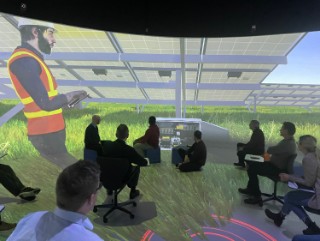
    In their joint “VR4PV” project, the Fraunhofer Center for Silicon Photovoltaics CSP, the Fraunhofer Institute for Factory Operation and Automation IFF, DENKweit GmbH and Dexor Technology GmbH conducted research on how to reduce the operating costs of solar parks and thus generate solar energy more cost-effectively in the future. Using a digital twin, novel measurement methods and machine learning, the research partners succeeded in optimising the operational management of photovoltaic parks.

    more info

Our Contribution to IEA PVPS Task 13

Founded in 1993, the IEA PVPS (Photovoltaic Power Systems Programme) is an international collaboration under the International Energy Agency (IEA). A total of 29 countries and organizations – including Germany, the USA, China, and SolarPower Europe – are working together to promote the sustainable use of photovoltaics for electricity generation.

Eight active research projects (Tasks) provide independent insights into key topics such as sustainability, system reliability, and market development. The program aims to advance PV technologies, support competitive markets, and inform energy transition policies.

Fraunhofer CSP is actively involved in Task 13 – Reliability and Performance of Photovoltaic Systems – with Senior Scientist Ulrike Jahn serving as a lead expert.

Below you will find all reports from our research group related to reliability and performance of PV systems.


An overview of floating PV (FPV) performance, focusing on energy yield, reliability, and O&M – supporting responsible deployment on inland and nearshore waters.


The report examines technical performance, modeling, and operational challenges of agrivoltaics, offering guidance for efficient and replicable global applications.


An overview of best practices and innovations in bifacial PV tracking systems – now the leading setup for utility-scale solar installations worldwide.


The report provides targeted recommendations to enhance the performance and reliability of PV systems in extreme climates. By analyzing climate-related stress factors and proven mitigation strategies, it serves as a practical guide for planners and developers worldwide.


The report analyzes key performance indicators (KPIs) for the operation of PV systems. It highlights challenges, application opportunities, and best practices for technical monitoring and data management in the photovoltaic sector.